We'll tailor buying guides and product links to your country. You can change this anytime from the top bar.
Home Healthcare & Monitoring · Buying guide
Best Blood Pressure Monitors for Home Use in 2026
Three home blood pressure monitors compared on cuff fit, clinical validation and irregular-heartbeat detection — to help you choose one you can trust between GP appointments.
A home blood pressure monitor is only useful if the number it gives you is one a clinician would accept. The NHS treats readings taken at home differently from those taken in a surgery — high blood pressure is considered to be 140/90mmHg or above at a GP practice or pharmacy, but an average of 135/85mmHg or above when measured at home — because the clinic setting itself pushes readings up in some people. That makes the device on your kitchen table part of the diagnosis, not a gadget.
Distributing Care compared three upper-arm monitors from Amazon UK’s current best sellers on the things that decide whether a reading is trustworthy: the cuff circumference each one fits, whether the manufacturer states clinical validation, and whether the device flags an irregular heartbeat while it measures. The picks are below.
How we tested & chose
Distributing Care built this shortlist from Amazon UK’s Best Sellers in Blood Pressure Monitors, taking the top ten by units sold and keeping only upper-arm devices sold as a specific, in-stock variant. Every specification quoted here — cuff range, display type, stated validation status — was read off the live manufacturer listing on 10 August 2026, and clinical guidance is taken from the NHS and from NICE guideline NG136 on hypertension in adults.
What we weighed
Cuff circumference range and fitStated clinical validationIrregular-heartbeat detectionDisplay legibility and one-touch operation
A blood pressure monitor does not diagnose anything. If your home readings are consistently at or above 135/85mmHg, or if a device repeatedly flags an irregular heartbeat, take the readings to your GP rather than acting on them yourself. The British and Irish Hypertension Society publishes a list of independently validated devices, and it is worth checking any monitor against it before you rely on it.
The picks, reviewed
No products have been added for United States yet.
Best Overall9.4/ 10 · Care Score
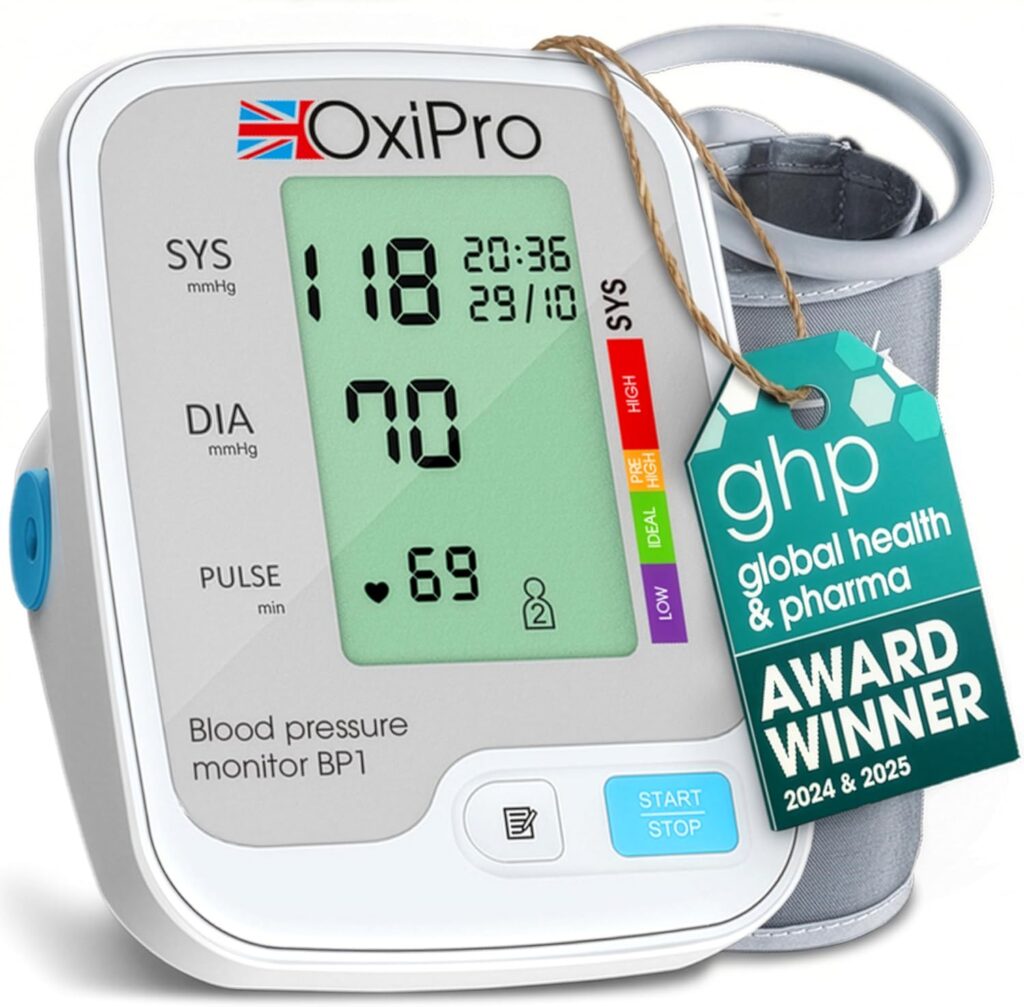
OxiPro BP1 Blood Pressure Monitors - Health & Pharma Recommended - BP Blood Pressure Machines for Home Use with Heart Rate Monitor & Large Cuff - Blood Pressure Monitors, White
Amazon UK's best-selling home blood pressure monitor, with a large cuff supplied as standard.
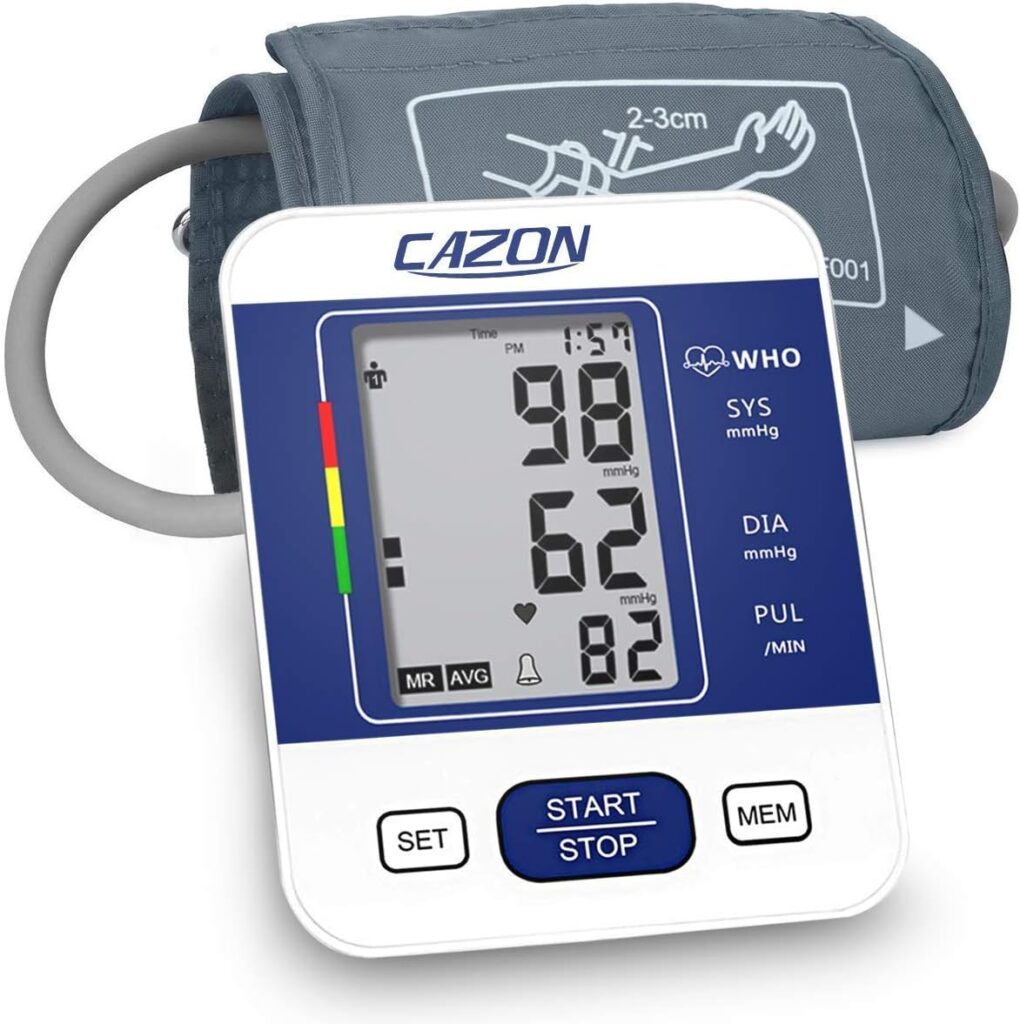
CAZON Blood Pressure Monitors Large Cuff Blood Pressure Machine BP Monitor Upper Arm BP Cuff for Home Use Heart Rate Hypertension Monitor, Cuff 22-40cm LCD Display (Blue)
Rank 2 best seller: a 22-40 cm cuff, for arms a standard 22-32 cm monitor cannot fit correctly.
No products have been added for United Arab Emirates yet.
Frequently asked questions
Quick answers to what readers ask most about home blood pressure monitors.
How do I take an accurate blood pressure reading at home?
Sit still for five minutes first, then take two readings a minute apart and record both. Sit with your back supported, feet flat on the floor and legs uncrossed, rest your arm on a table so the cuff is level with your heart, and put the cuff on bare skin rather than over a sleeve. Avoid caffeine, exercise and smoking in the half hour before measuring, and do not talk while the cuff is inflating — talking alone can add several mmHg to the result.
What blood pressure reading is considered high in the UK?
The NHS considers blood pressure high at 140/90mmHg or above when measured at a GP surgery or pharmacy, or an average of 135/85mmHg or above when measured at home. Home thresholds are lower because clinic measurements are inflated in some people by the setting itself — the so-called white-coat effect. A reading between roughly 90/60mmHg and 120/80mmHg is generally described as normal. One high reading is not a diagnosis; it is the average across several days that matters.
Does cuff size affect the reading?
Yes — cuff size is the most common cause of an inaccurate home reading. A cuff that is too small for the arm squeezes harder to occlude the artery and overestimates blood pressure, while an oversized cuff can underestimate it. Measure the circumference of your upper arm at its midpoint with a tape measure and check it falls inside the range printed on the cuff. Standard cuffs typically cover around 22–32 cm, so anyone above that needs a monitor supplied with a larger cuff rather than a standard one.
Are wrist monitors as accurate as upper-arm monitors?
Upper-arm monitors are the recommended choice for home measurement, and every device in this roundup is an upper-arm model. Wrist devices are more sensitive to position: the wrist must be held exactly at heart level or the reading drifts, and the arteries there are narrower and shallower, which makes measurement less reliable. Wrist monitors have a place where a cuff cannot be fitted to the upper arm, but they should be independently validated and their readings checked against an arm device where possible.
How often should I measure my blood pressure at home?
For diagnosis, NICE guideline NG136 describes taking two readings a minute apart, twice a day — morning and evening — for at least four days and ideally seven, then discarding the first day and averaging the rest. That average is the figure a clinician will want. Outside a diagnostic period there is no benefit to measuring many times a day; frequent spot checks mostly capture normal variation and cause unnecessary worry. Agree a monitoring schedule with your GP if you are being treated for hypertension.
Some links above are affiliate links. As an Amazon Associate we earn from qualifying purchases, at no extra cost to you. Links go to Amazon.com. Prices are illustrative — check the current price before buying.
Medical disclaimer. This guide is for general information only and is not medical advice. It is not intended to diagnose, treat, cure or prevent any condition. Always speak to a qualified healthcare professional before starting any new product, especially if you have an existing condition or take medication.